
How to Search Seneca County Civil Dockets
There is no single countywide civil docket in Seneca County. Common Pleas Civil and Domestic Relations cases live online in the Seneca County Clerk's Court Case Inquiry. Municipal Civil and Small Claims matters sit somewhere else. The Tiffin-Fostoria Municipal Court Record Search is the right portal for those. Both systems ask you to accept a notice. They also require a CAPTCHA. Filings and judicial action can appear late. So treat what you see as a locator for the court record rather than an authenticated copy.
A case number or the parties' names gets you started. On the Common Pleas side, the Name/Company field expects last-first-middle order. The filters there cover Civil and Domestic Relations. Municipal CaseLook takes a name or company, hearing date, case number, file date, or ticket number. Civil and Small Claims filters are included. A ticket number rarely matters in an ordinary civil dispute. Even so, the shared Municipal system still offers that field.
- Identify whether the matter belongs in Common Pleas or Tiffin-Fostoria Municipal Court.
- Open that court's public search and accept the access notice.
- Use a party name, case number, or date field, then narrow the civil case-type filter when it helps.
- Open the matching case result and read its docket entries and any next setting.
- For a verified order, judgment, or copy, contact the clerk who keeps that court's file.
When a portal leaves questions open, go straight to the right office. Common Pleas matters belong to the Clerk of Courts Legal Department by phone, at the counter, or through its records-request process. Municipal matters go to the Tiffin or Fostoria clerk, whichever applies. No search result can replace the clerk's authenticated record.
Seneca County Civil Courts Compared
Where a case is filed decides which docket you search. Substantial civil work and domestic relations matters sit with the Seneca County Court of Common Pleas, General and Domestic Relations Divisions. Tiffin-Fostoria Municipal Court takes civil claims within its monetary jurisdiction and runs a separate Small Claims docket beside its regular civil docket. The Municipal civil limit is $15,000. Small Claims caps at $6,000. Those dollar limits explain why a civil docket search in Seneca County cannot start and end with one local portal.
| Court | Civil docket scope | Search path |
|---|---|---|
| Common Pleas | Negligence, contracts and labor disputes, foreclosure, declaratory judgments, injunctions, personal injury, real estate, malpractice, and domestic relations matters. | Clerk Court Case Inquiry, Civil or Domestic Relations filter. |
| Tiffin-Fostoria Municipal | Regular civil claims up to $15,000 and Small Claims up to $6,000. | Municipal CaseLook, Civil or Small Claims filter. |
The municipal court sits in two places. It runs one CaseLook system. Tiffin serves the city itself, the listed villages, and most Seneca County townships. Fostoria serves the City of Fostoria. It also covers Jackson and Loudon Townships in Seneca County. Whichever court appears on the filing and setting controls which clerk you contact.
What a Civil Docket Shows
Think of a docket as the court's chronological register of case activity. The local portals describe their search fields. Calendar tools are covered too. The guidance here is a careful Seneca County and Ohio reading guide. Not every screen shows every item, so read with care. Check the court and the caption. Note the filing date, later entries, the current setting, and the disposition. Verify those facts before you rely on a result.
| Case number | The court's identifier. Common Pleas shows an example such as 20CR1234, while Municipal CaseLook instructs users to enter numbers only and no letters. |
|---|---|
| Parties | The plaintiff or petitioner who started the matter and the defendant or respondent who must answer it. |
| Filings | Dated documents or events, such as a complaint, answer, motion, notice, order, or judgment entry. |
| Setting | A scheduled hearing or court event. Confirm it with the court because local portals warn of posting delay. |
| Disposition | The recorded outcome or current resolution, such as judgment, dismissal, appeal, or satisfaction of judgment. |
Entry words mark activity. They do not restate every page of a filing. A motion entry, for instance, only signals that a written request was made. For an authenticated filed order or judgment, ask the clerk.
Seneca Civil Portal Number Rules
Never carry a number from one Seneca County civil system into another without checking its format. Common Pleas shows a case-number example that includes letters. Municipal CaseLook asks for numbers only, with no letters. That contrast proves no particular civil prefix or code. It does show why copying the identifier exactly from a court notice beats guessing from a number built for a different court.
- Court Case Inquiry
- The Seneca County Clerk's public name for the Common Pleas lookup service, including a separate Calendar Search tab.
- CaseLook / Record Search
- The public interface used by Tiffin-Fostoria Municipal Court for civil, small claims, and other municipal case types.
- Calendar Search
- A date-range search for settings, rather than a search designed only to identify a case by party or number.
Both Seneca County systems let you pick a result size and require CAPTCHA verification. Suppose the right court and the exact number still return nothing. A recent filing may simply not show online yet. Call the clerk with the case context. An empty screen is not proof that no record exists.
Types of Civil Cases on the Seneca County Docket
The Seneca County civil docket splits by court and case type. Common Pleas lists broad civil categories plus Domestic Relations. Municipal Court keeps its own regular Civil and Small Claims categories. A category filter narrows a search. But it cannot substitute for knowing which court received the complaint.
- Common Pleas civil matters, including contracts, negligence, real estate, tort, malpractice, foreclosure, administrative appeal, declaratory-judgment, and injunction cases.
- Common Pleas domestic relations matters, including divorce, dissolution, legal separation, support, custody involving married couples, and certain protection-order requests.
- Municipal regular civil claims within the court's $15,000 limit.
- Municipal Small Claims matters within the $6,000 limit.
- Municipal filings whose court forms include civil complaints, appeal petitions, motions to continue, garnishment affidavits, and notices to leave premises.
Tiffin-Fostoria Municipal Court's Small Claims information lays out the local small-claims filing process and jurisdiction.
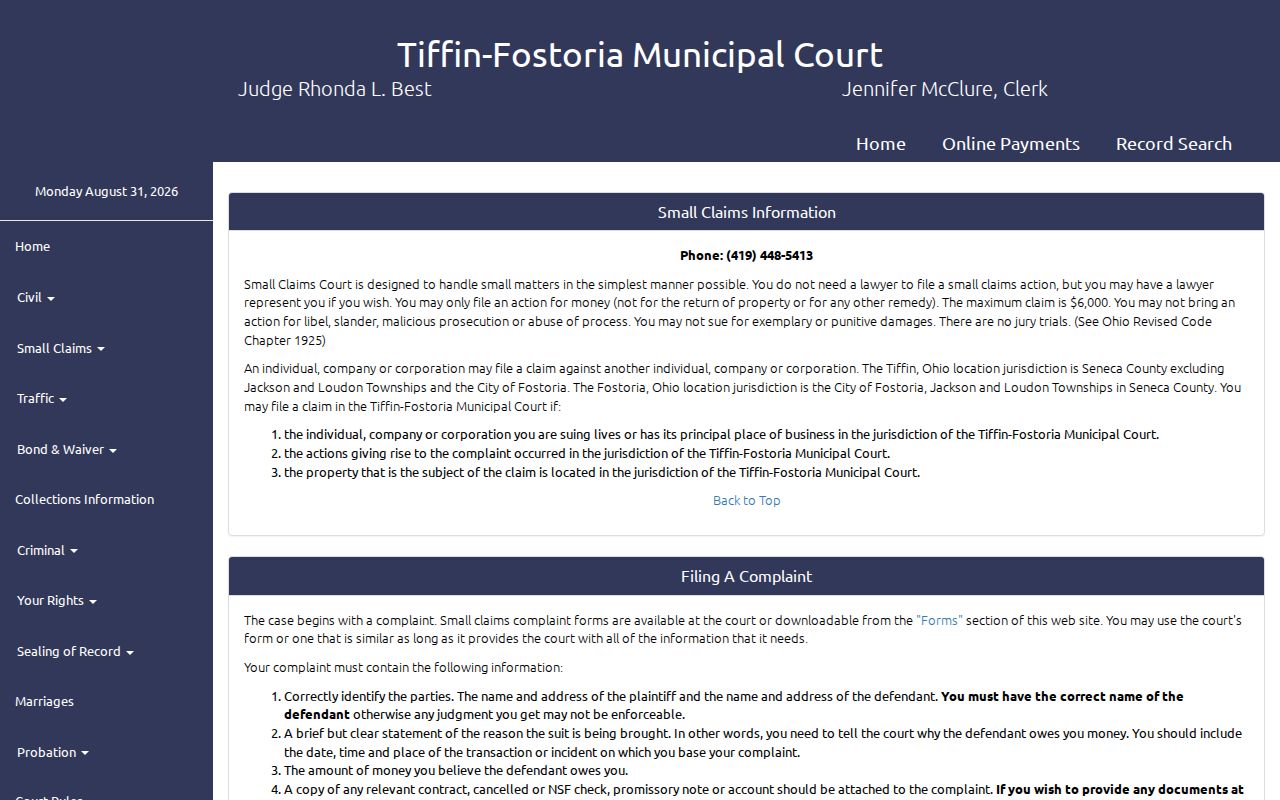
The court's Small Claims material separates that docket from regular municipal civil work. That distinction is why the case-type filter matters in a Seneca County docket search.
Seneca County Small Claims Timeline
A Tiffin-Fostoria Small Claims case starts when someone files a complaint. From there, the court schedules a hearing. Seneca County filers can expect that hearing soon after. The gap runs roughly 30 to 40 days from when the complaint lands. Treat that span as a general rhythm, not a promise. The date printed in the case record controls. A party who just filed or was served should read the court notice instead of counting forward on a calendar.
A few civil terms make the sequence easier to follow. The complaint opens many civil actions. Service is how the papers formally reach the other side. An answer is the responding party's filing, and a motion asks the court to act. A judgment records the court's resolution. Later on, garnishment or satisfaction of judgment can show up in the docket history. One caution on labels. Seneca County publishes no Civil CaseLook code legend for terms like “DWOP” or “nonsuit.” So do not read those as known local status codes. Note: the complaint-to-hearing interval is local normal practice. The setting in the case record is the date to follow.
Settings and Hearings on Civil Dockets
Finding a Seneca County civil setting means using the right court's tool. Common Pleas offers its Calendar Search tab. It requires a Beginning Date, and it takes an optional ending date. Municipal CaseLook has a Calendar Search of its own for municipal date ranges. Pick the correct Seneca County court first. Then confirm the location and time through the date tool, the case result, and the clerk.
When a date needs to move, a motion to continue asks the court for that change. Common Pleas local rules require the motion in writing. It must state the reason, address service and consent, and disclose prior continuances. Same-day continuances are not allowed without good cause. Results can also lag judicial action by at least 24 hours. So a moved or removed date deserves a direct check. For a fuller walkthrough of locating and verifying a setting, see the Seneca County court calendar.
Seneca Civil Filing and Docket Access
Filing a case and reading the public docket are two different tasks. The Seneca County Clerk connects Common Pleas filers to its local Electronic Case Filing channel. The public Court Case Inquiry serves as the search tool for a case or calendar. E-filing does not replace the public civil-docket search path. A Seneca County filer stays responsible for proof or certificate of service unless Civil Rule 4 requires service. The Clerk's Common Pleas electronic filing page identifies the local ECF channel. It also shows what a filer will encounter there.
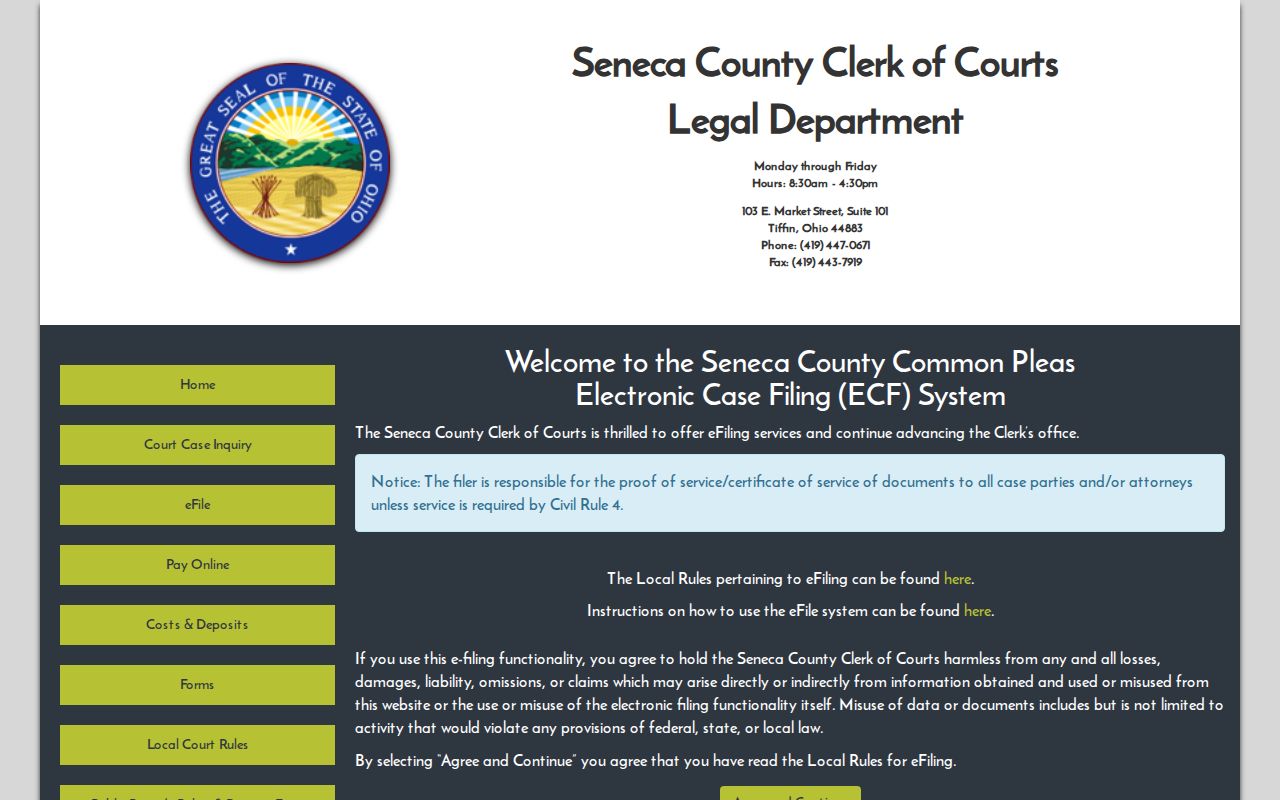
The ECF screen is for filing only. Court Case Inquiry and Calendar Search remain the public tools for finding Common Pleas civil activity and hearing dates. Tiffin-Fostoria Municipal Court local rules and filing information publishes that court's civil-rule materials.
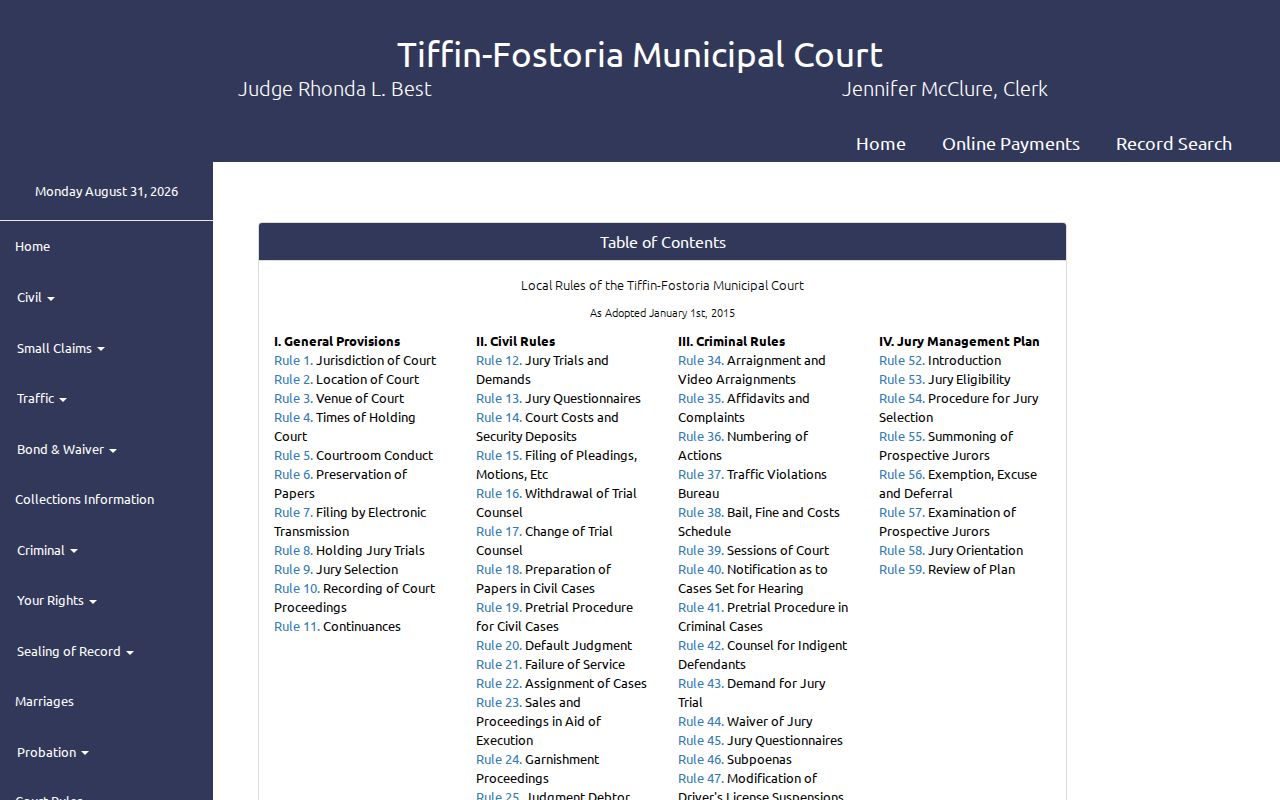
Municipal civil rules supply the procedural context for filings and continuances. For a specific civil case record, the CaseLook result and the clerk are still the routes.
Public Access to Seneca County Civil Dockets
Ohio court-record access runs mainly through the Ohio Rules of Superintendence, not through treating every Seneca County court file as an ordinary county public-records request. Online results from Common Pleas and Municipal can help locate a civil case. The local notices warn that data can be delayed or changed. Verified information comes from the clerk or court that maintains the record.
Key Rules:
Ohio Sup.R. 11.09 defines the current court-record access framework.
Ohio Sup.R. 11.10-11.14 address presumptive access, remote and direct access, redaction, and restrictions.
R.C. 2303.12 requires Common Pleas clerks to keep statutory dockets and records, subject to restrictions and exceptions.
Some materials stay off the remote view. Records sealed by law or court order may not be available remotely or in full. The same goes for documents with protected personal, health, or financial information, and other restricted items. Seneca County Domestic Relations cases can appear in Case Inquiry. Their individual documents can remain restricted. Ask the clerk whether a requested item is available and which access channel applies.
Seneca County Civil Record Verification
For a verified Common Pleas record, one office does the preserving. The Seneca County Clerk of Courts Legal Department keeps the Common Pleas civil and domestic relations pleadings. The Tiffin-Fostoria clerk handles its own municipal civil and small-claims files. Knowing which office holds which court records matters as much as running the online search. A request sent to the wrong office can stall the answer, even when several courts share the Justice Center address. The Clerk Legal Department's official page identifies the Common Pleas records it processes and preserves.
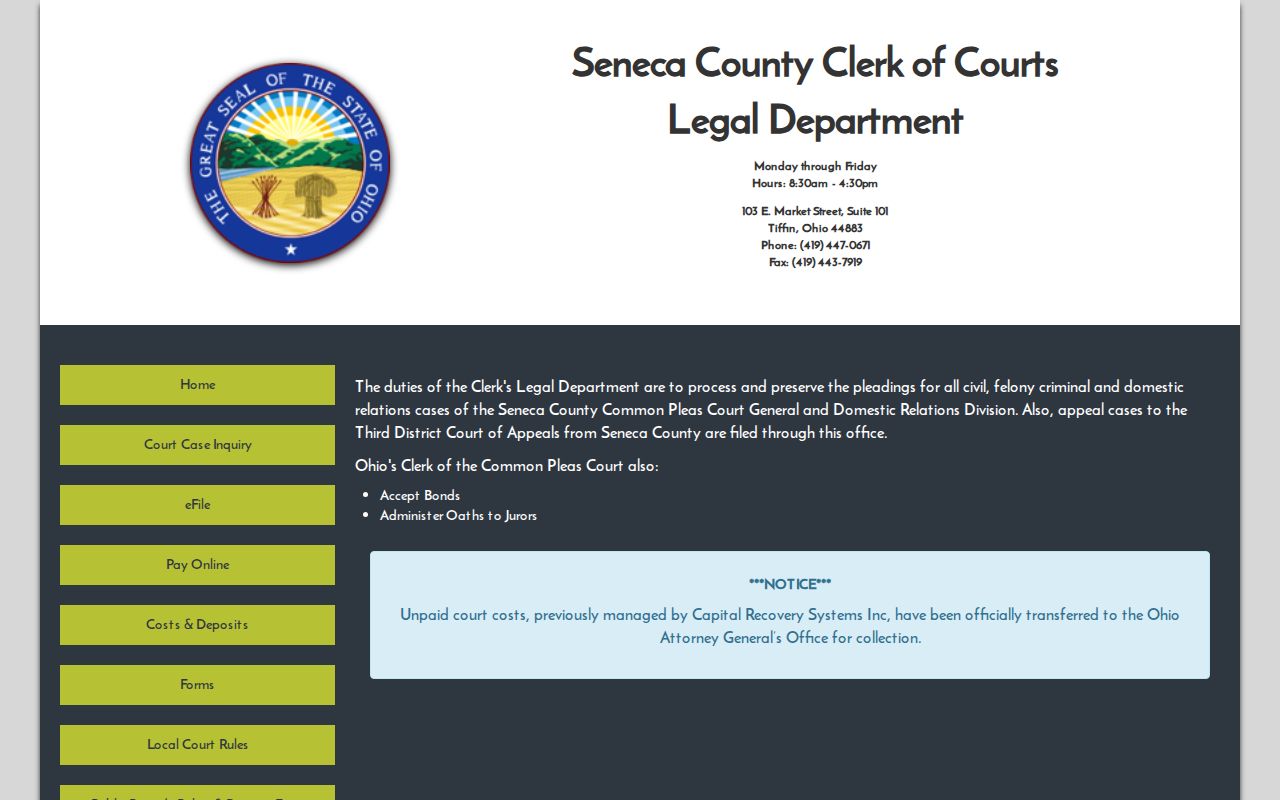
Common Pleas civil records have a designated clerk, not a generic countywide civil-records counter. Copy fees differ by court, so match the price to the right one. Seneca County Municipal Court lists ordinary copies at $.25 per page, certified copies at $3 per page, authenticated or exemplified copies at $5, and a certificate of judgment at $10, effective July 25, 2025. Those are Municipal Court fees alone. They are not Common Pleas fees. The Legal Department posts no Common Pleas certified-copy price list, so ask before ordering. Ohio Revised Code 149.43 offers public-records context. But it does not bypass the court-record rules governing a particular civil file.
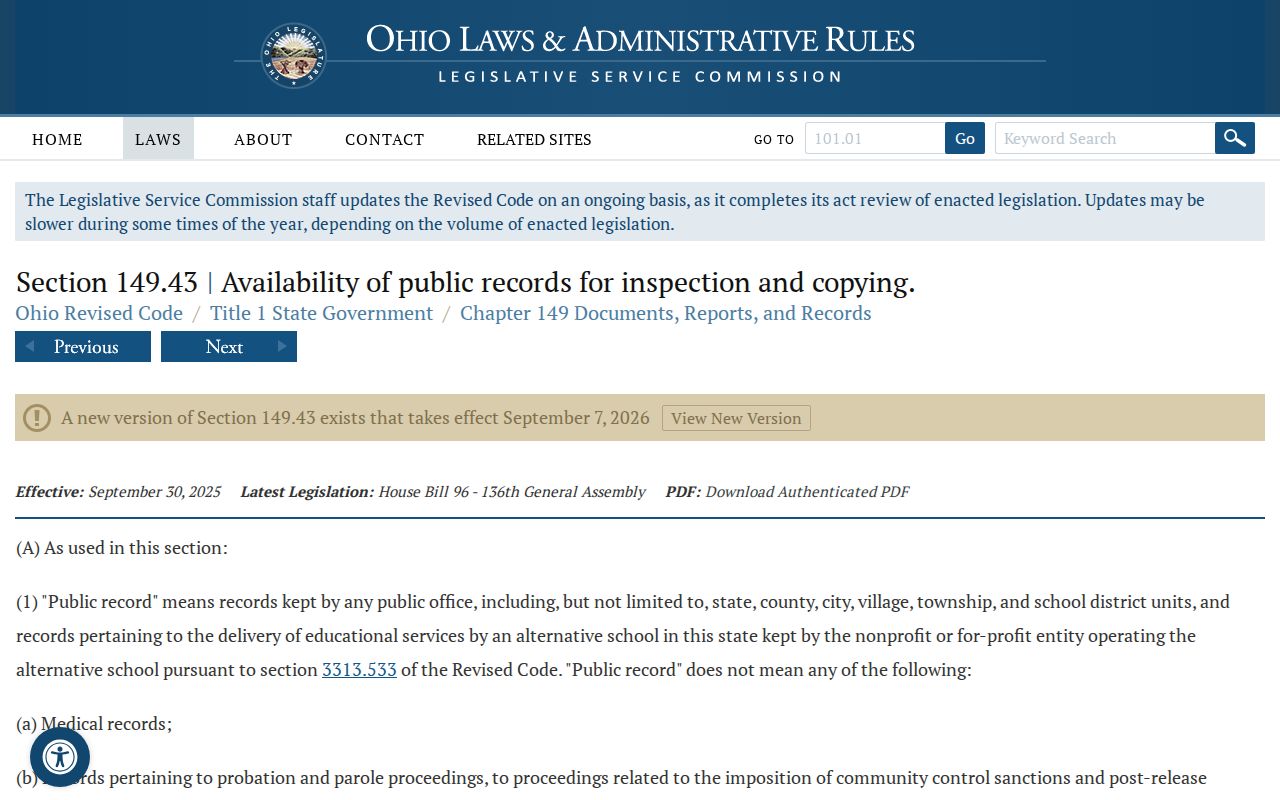
The Ohio Public Records Act still shapes county policy and some clerk-administered requests. Access to a given court document depends on the applicable court rule and the office holding it.